Robin Hood Gardens
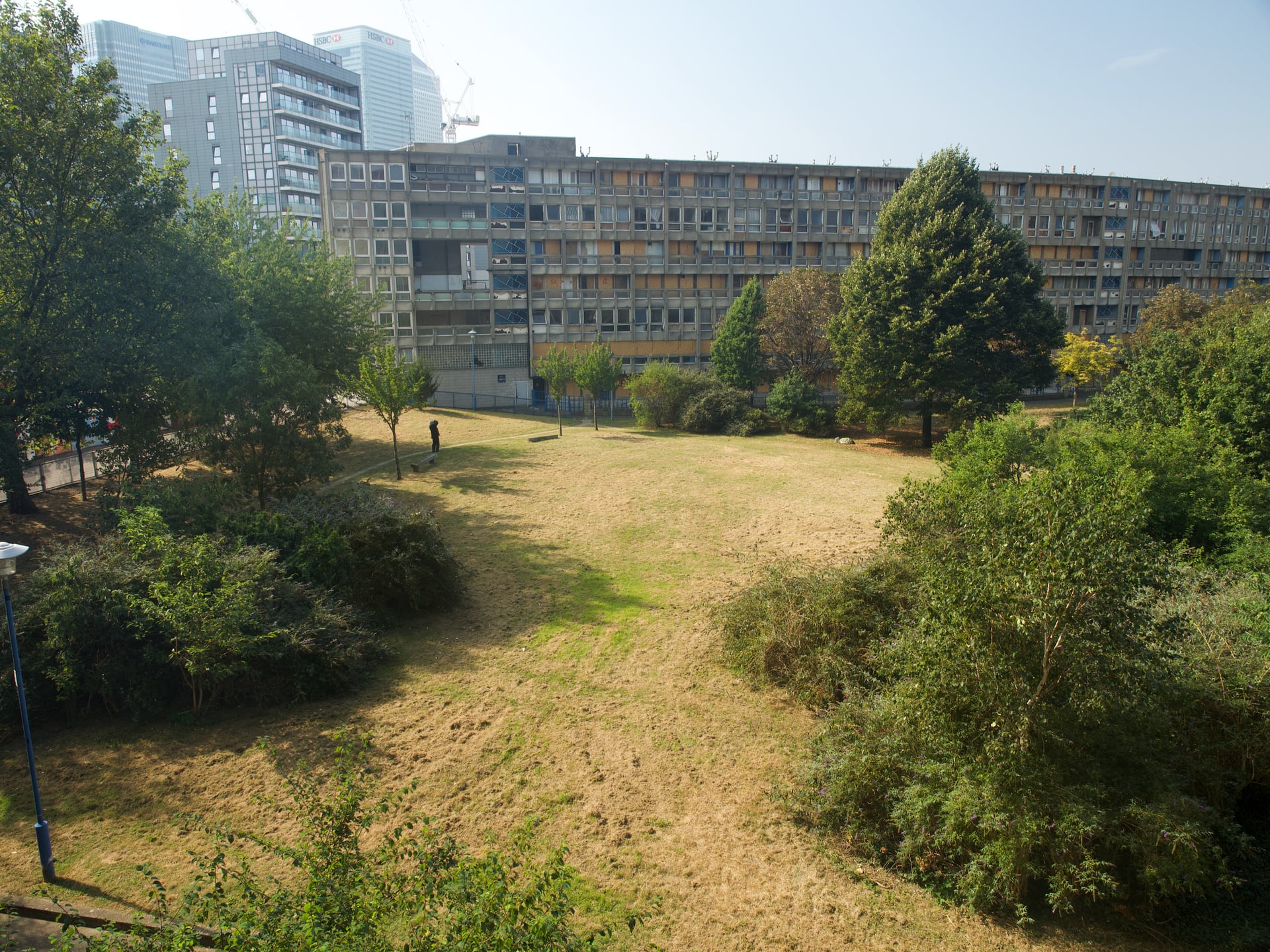
Robin Hood Gardens was built for the Greater London Council to a design by Alison and Peter Smithson. It had 214 flats in two long concrete blocks in Poplar, with decks every third floor, around a landscaped mound. It was completed in 1972.
In March 2008 Tower Hamlets Council, which had taken it over from the GLC, decided to demolish it. A 2008 estimate put the repairs at £20m or more. The government granted immunity from listing in May 2009.
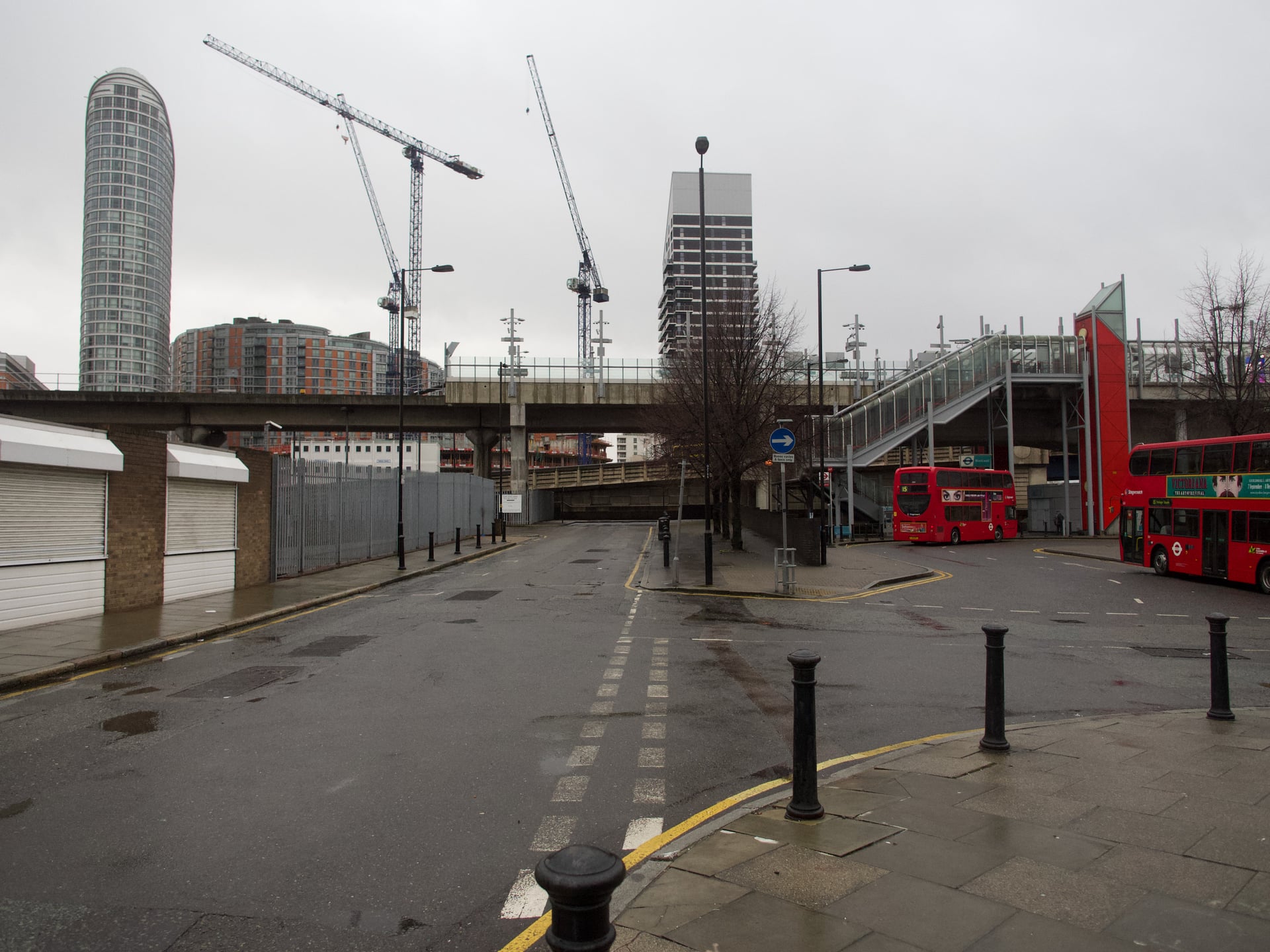
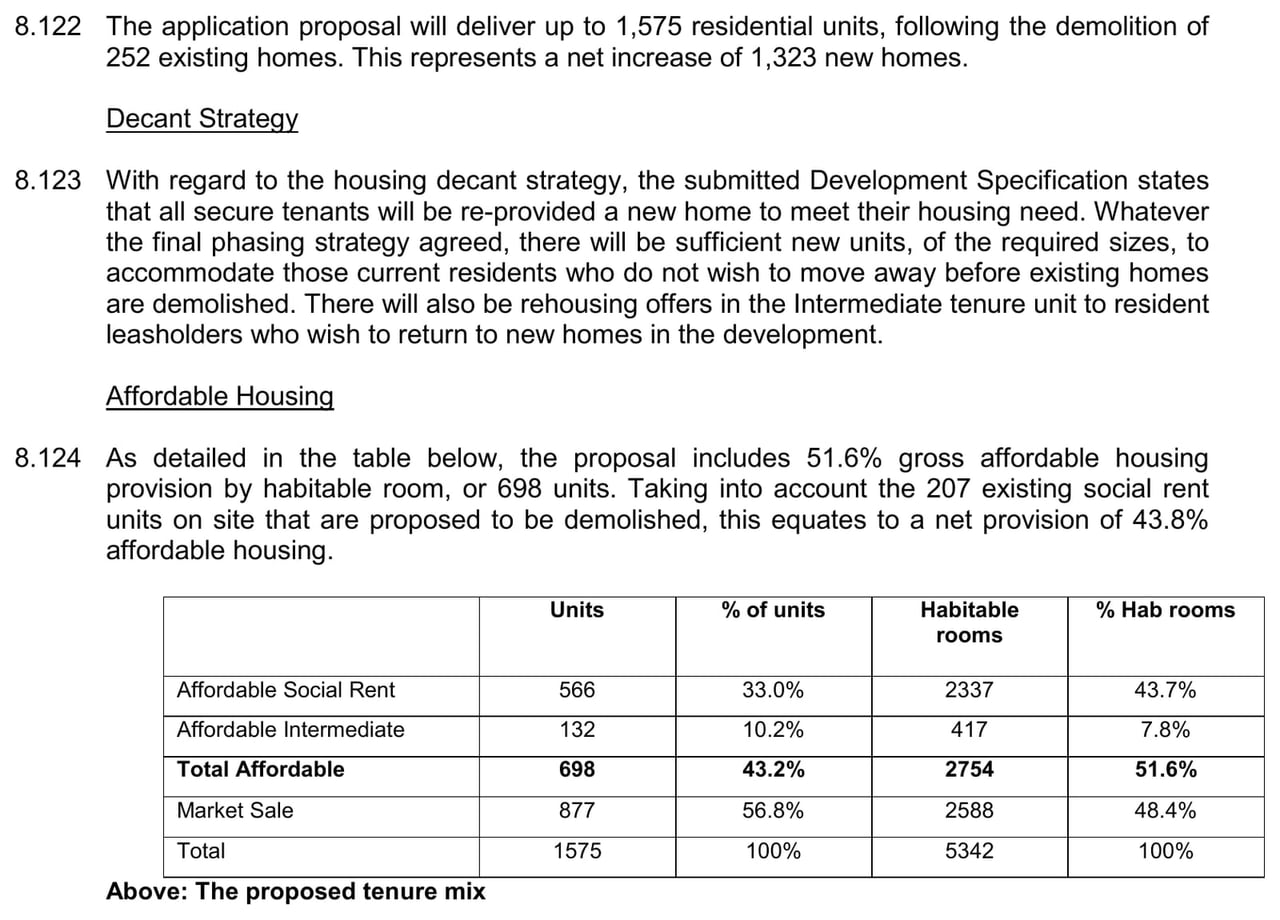
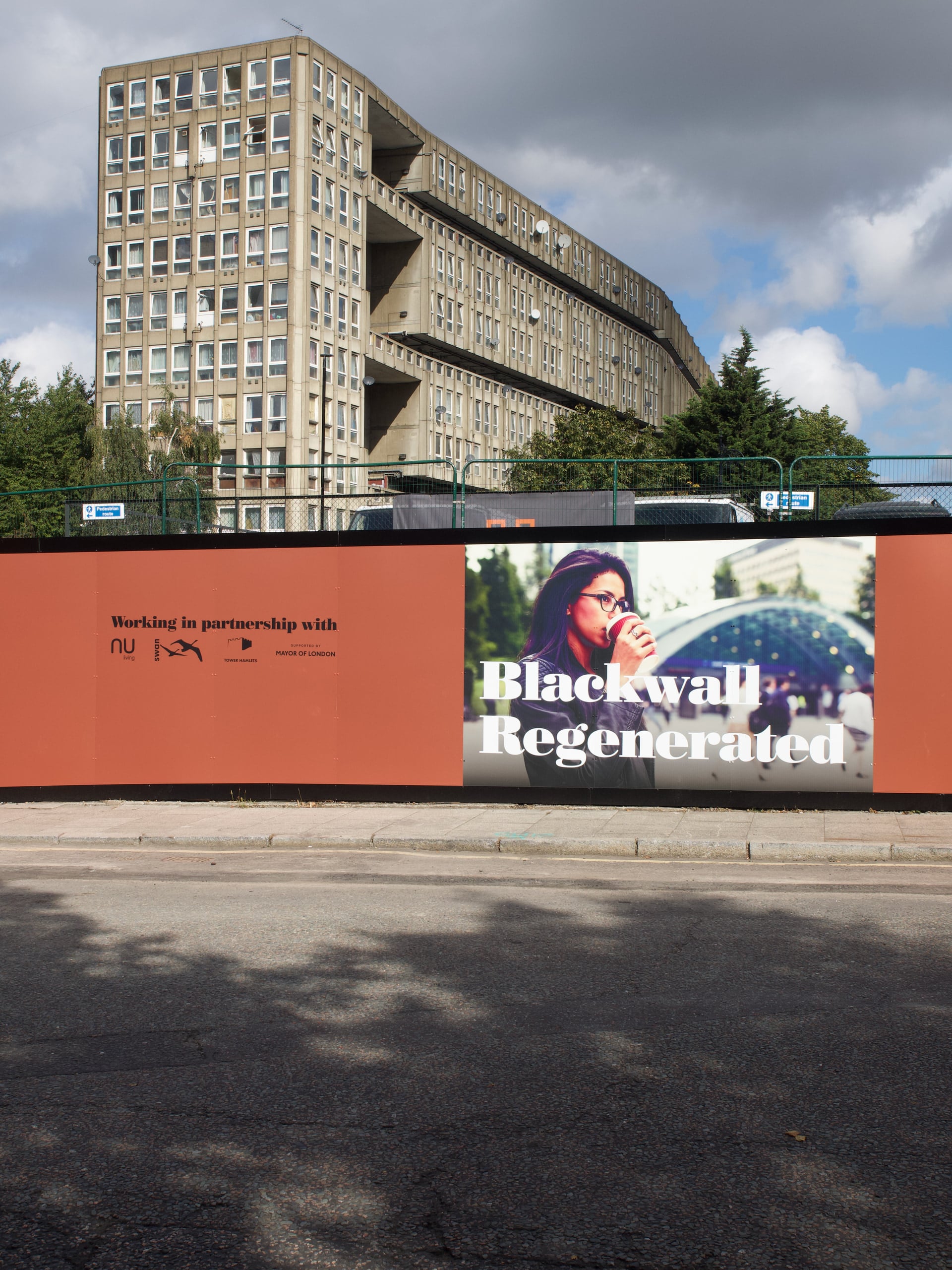
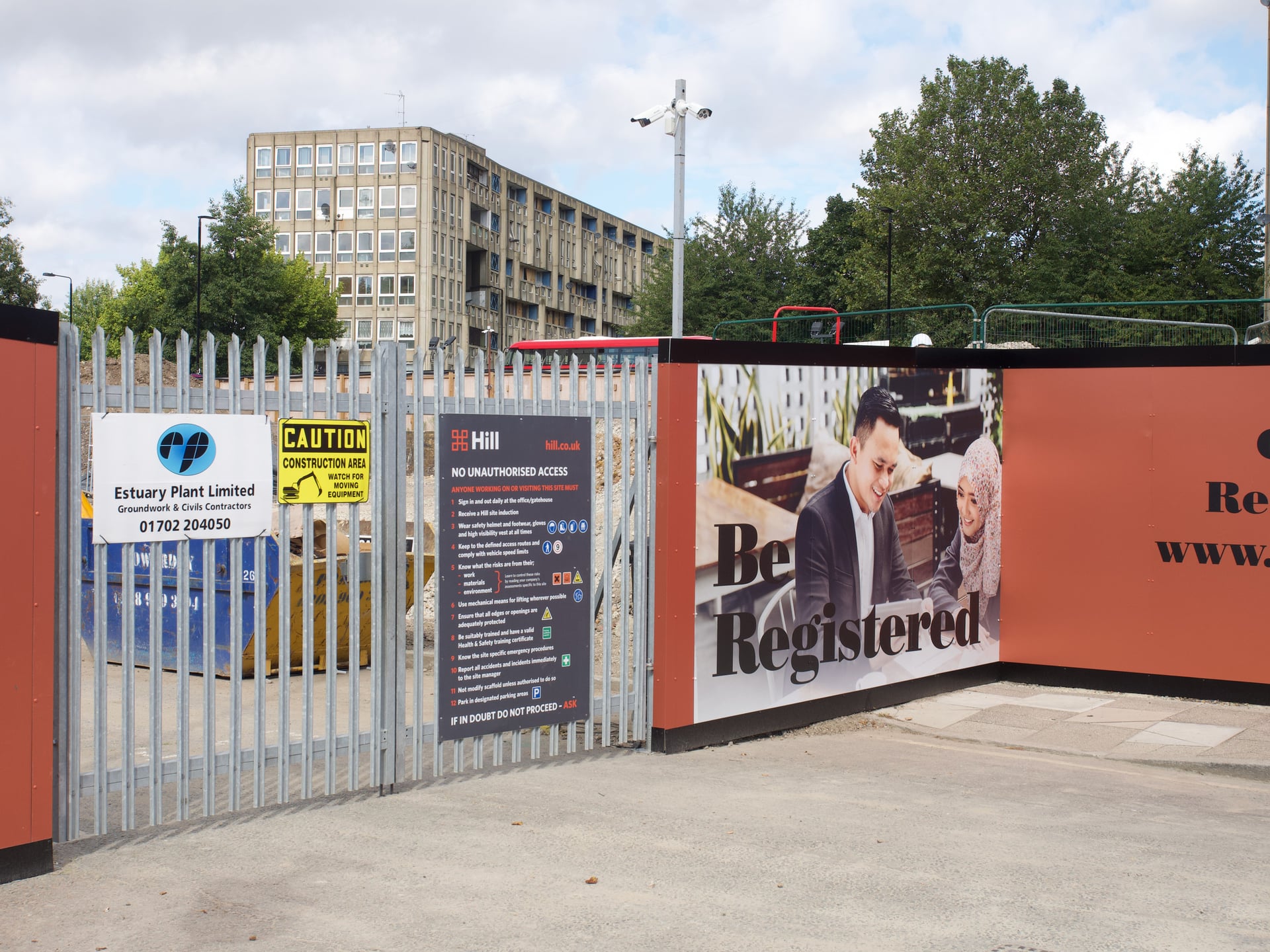
The west block came down from December 2017 and the east block in spring 2025. The site is now Blackwall Reach, with permission for up to 1,575 homes.
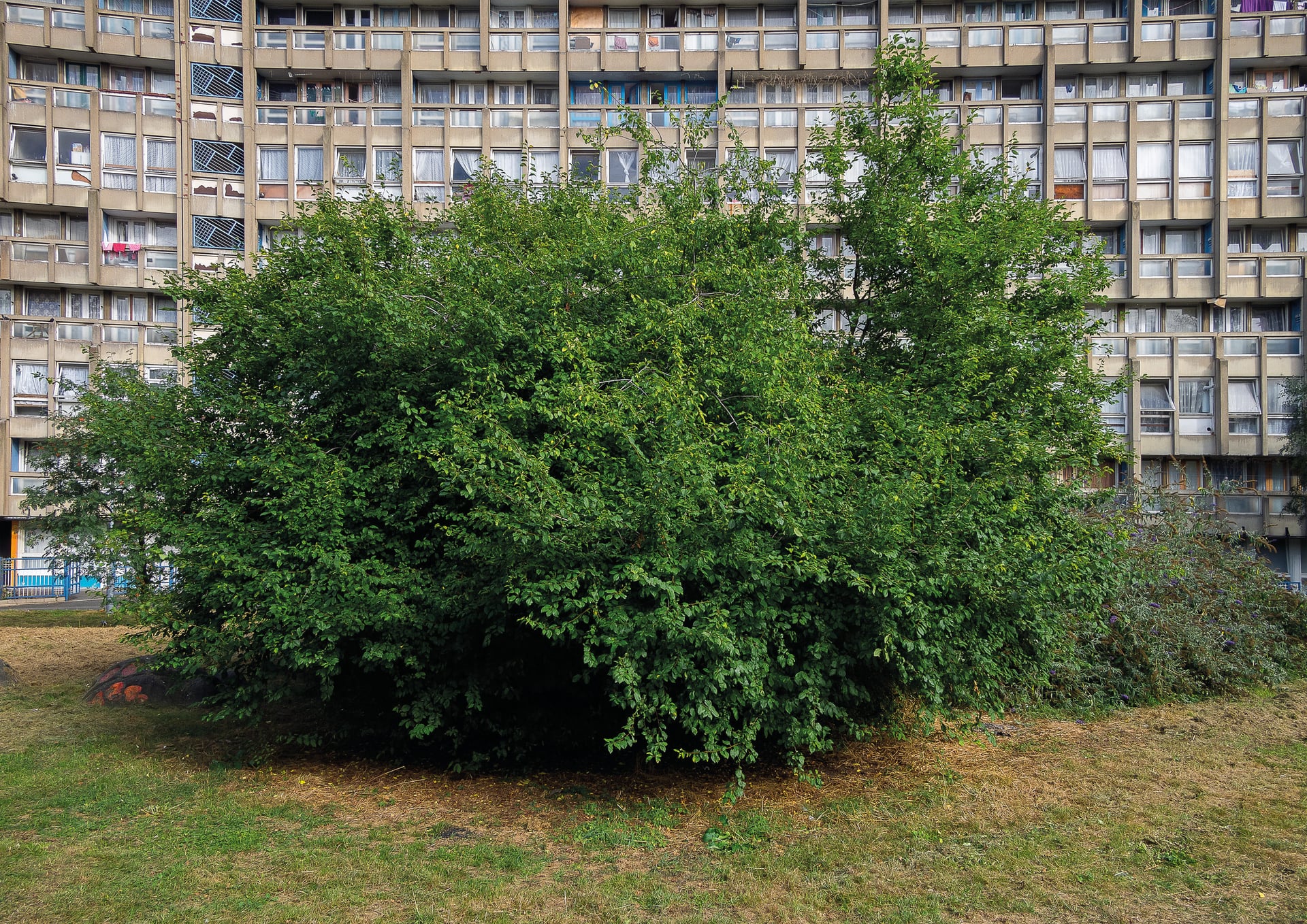
I photographed the estate in January 2014, and again in April and September 2016, when the west block had been emptied and the east block was still lived in.
- Architect
- Alison and Peter Smithson, for the Greater London Council
- Built
- Commissioned 1963 by the London County Council; new brief 1966 from the Greater London Council; on site 1968; completed 1972
- Homes
- 214 flats in two blocks of seven and ten storeys
- Listing
- Listing refused 2008; certificate of immunity from listing 13 May 2009; in August 2015 the minister was minded to approve a second
- Status
- Demolished: west block December 2017 to spring 2018, east block December 2024 to spring 2025
- Visits
- January 2014; April and September 2016
The encounter
I first walked round Robin Hood Gardens in January 2014, a few months before I began photographing at Balfron Tower, a short walk away. I went back in April and September 2016, when the west block had been emptied and the east block was still lived in.
In September 2016 I showed photographs there with Transition Photographers, in a basement room the council lent us, as Robin Hood Gardens: Out of Time. Peter Luck and I wrote the history panels, which began: “Robin Hood Gardens has probably gathered to itself more mythology than any other social housing in Britain, certainly than any other in London.” We meant the show as a start on freeing its story “from the myths, positive or negative”.
The promise, 1963–72
The London County Council gave the Smithsons their first commission in Poplar in 1963, for a site on Manisty Street. The Greater London Council, which replaced it in 1965, agreed to clear the nearby Grosvenor Buildings, and the site grew. A new brief came in 1966, building began in 1968, and the estate was finished in 1972.
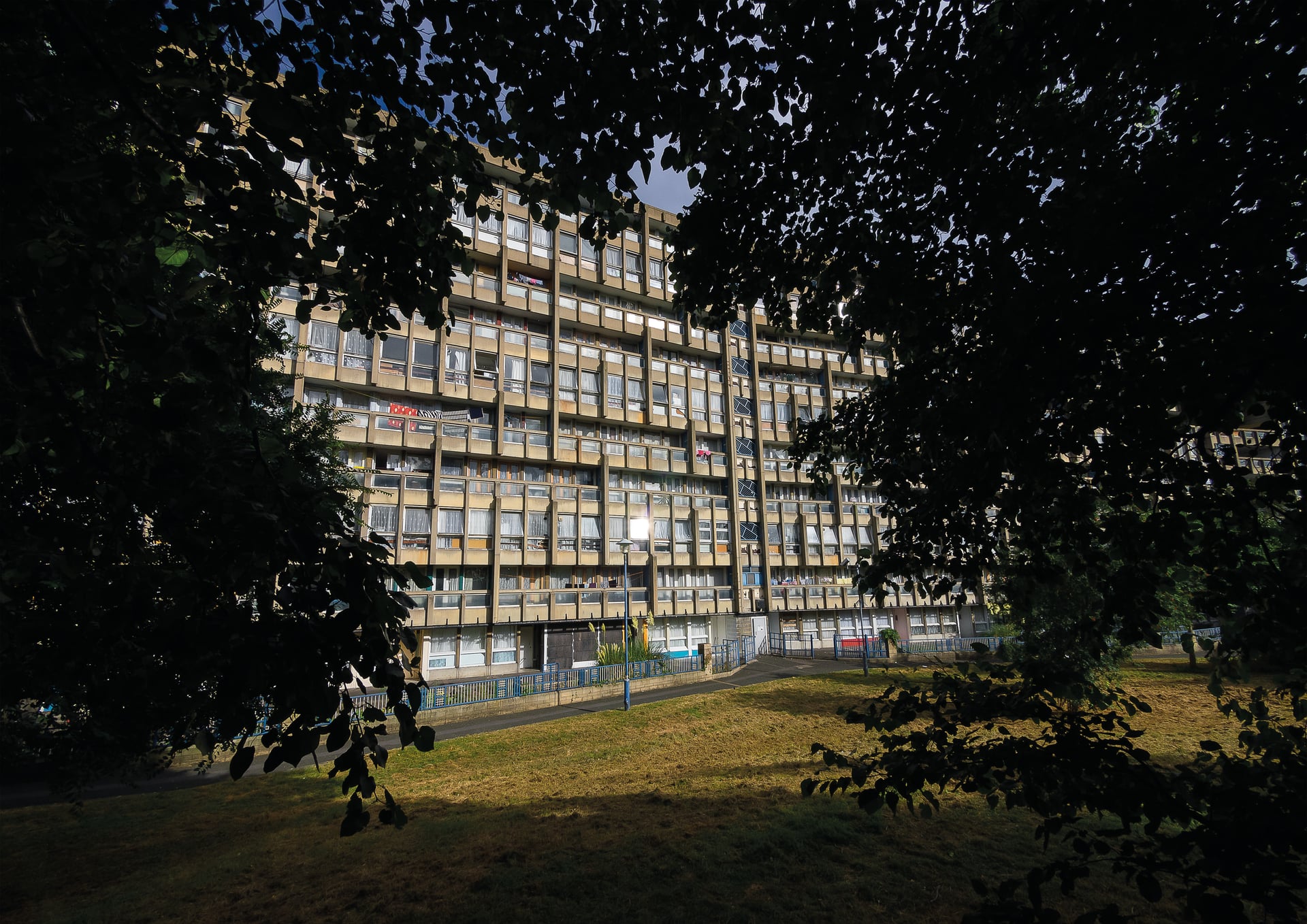
Two long blocks, one of seven storeys and one of ten, follow the line of the roads on either side and shelter a garden between them. The decks were planned for the road side every third floor, with the living rooms. The bedrooms and dining-kitchens were planned to look over the garden.
The mound in the middle was made from the rubble of the buildings cleared for the estate. The Smithsons called the scheme “a demonstration of a more enjoyable way of living”.
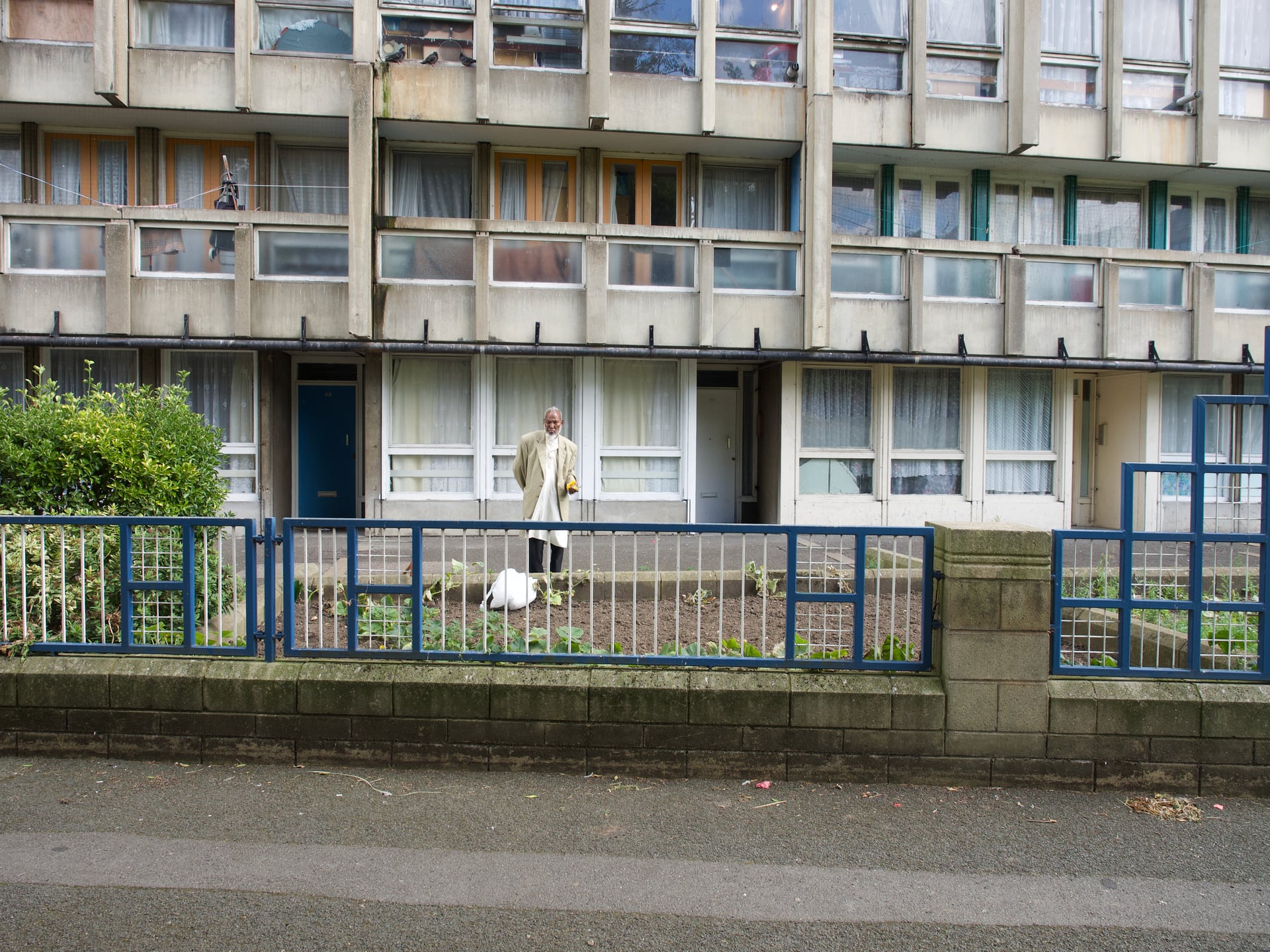
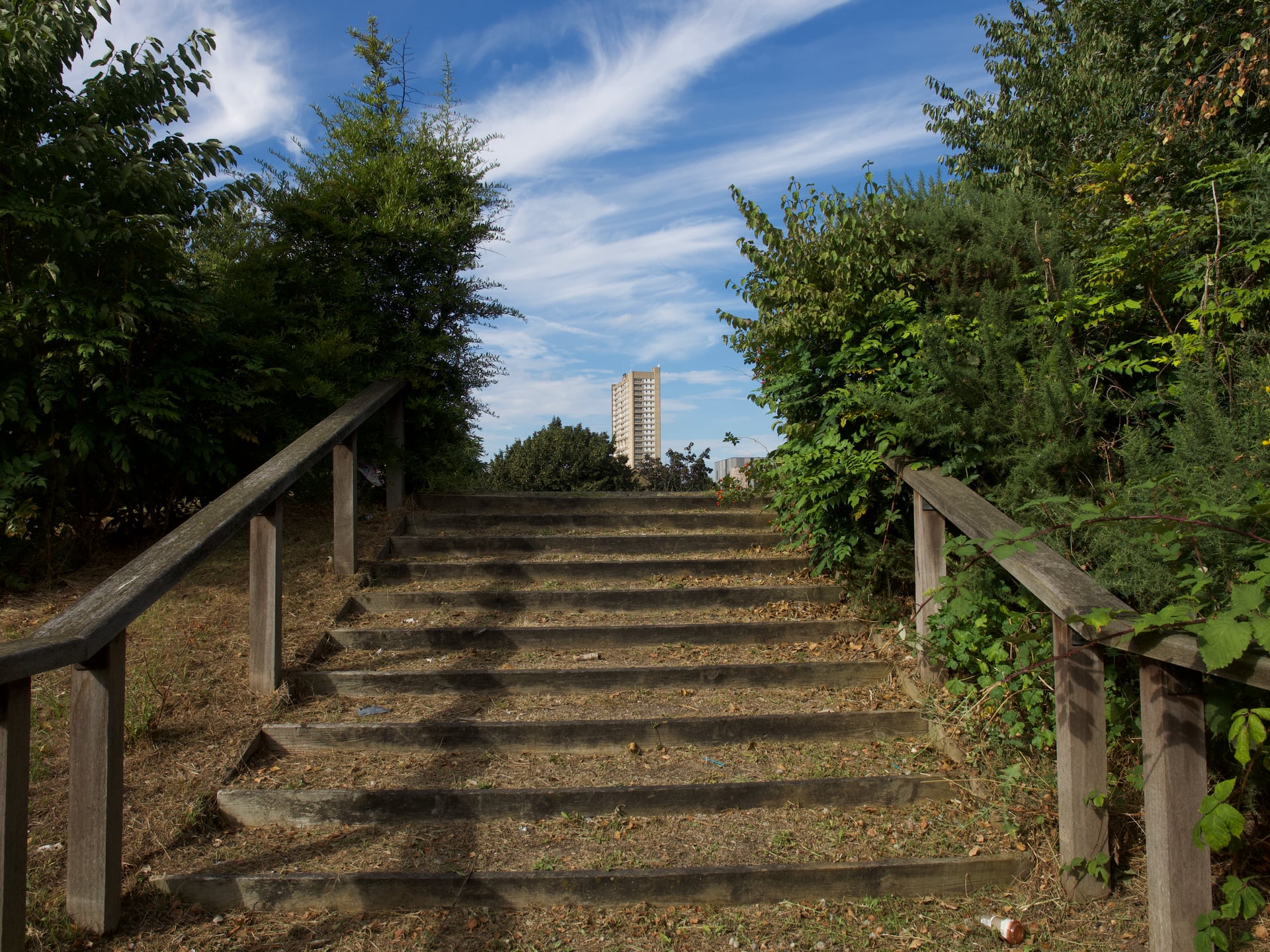
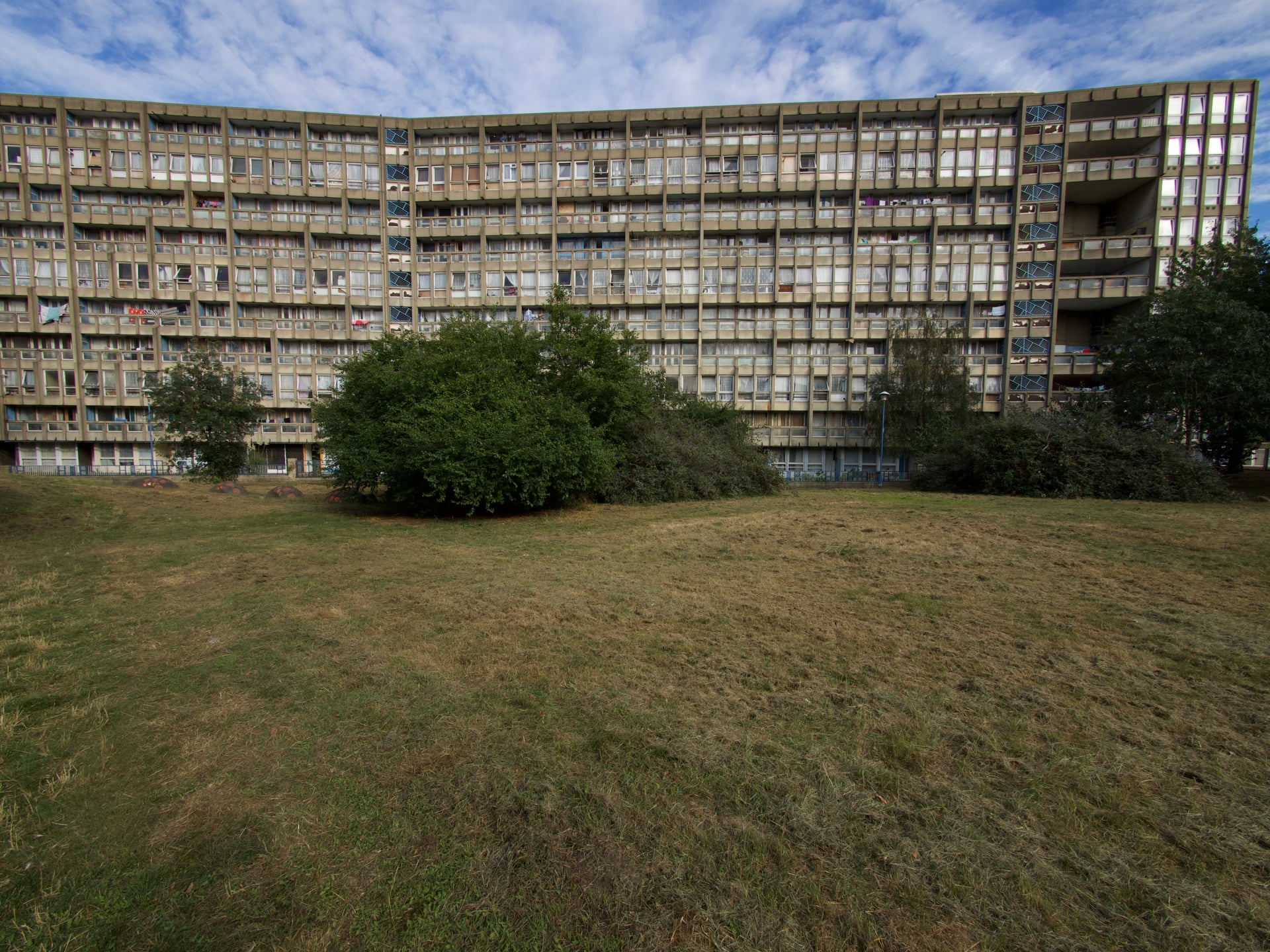
The manual issued to those moving in stated: “The Greater London Council and its architects have been working on Robin Hood Gardens since 1963; its builders since 1968; it is now your turn to try and make it a place you will be proud to live in.”
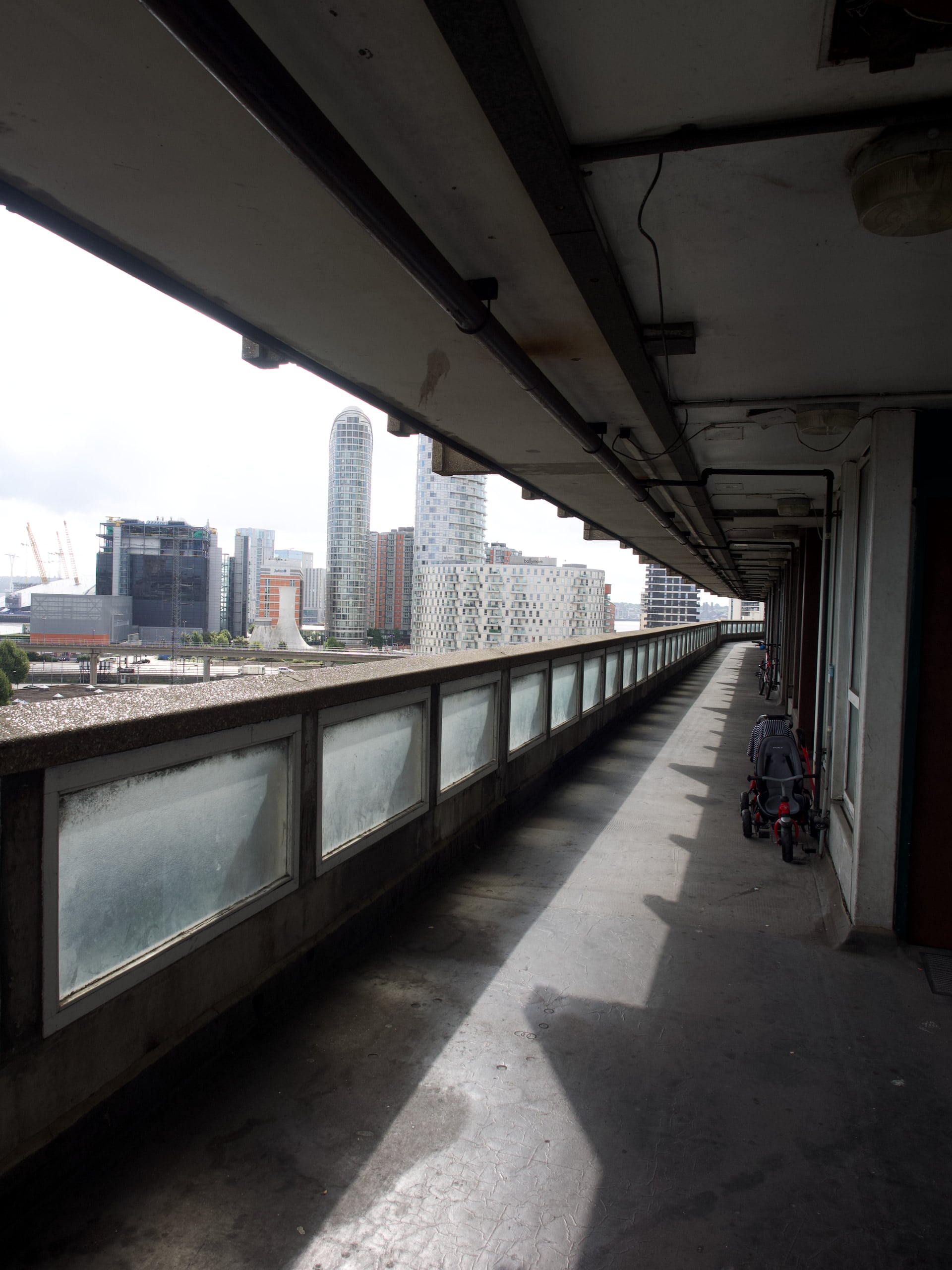
The deck itself is wide enough for the milkman to bring his cart along or for two women with prams to stop for a talk and still let the postman by.
The reputation, 1972–2007
There was vandalism early on, though the reasons are not clear. In 1974 Alison Smithson wrote “The Violent Consumer”, trying to make sense of it.
Historic England advised against listing for the second time in August 2015. Its head of designation said the “streets-in-the-air” approach was “at least 20 years old” by 1972, and the architecture “bleak in many areas, particularly in communal spaces”.
Residents interviewed by Kois Miah and Nick Thoburn for Brutalism as Found spoke of the decks differently. “Here we all know each other,” William Fakamus said. Motiur Rahman remembered: “We always talked about the walkways being like Bangladesh.”
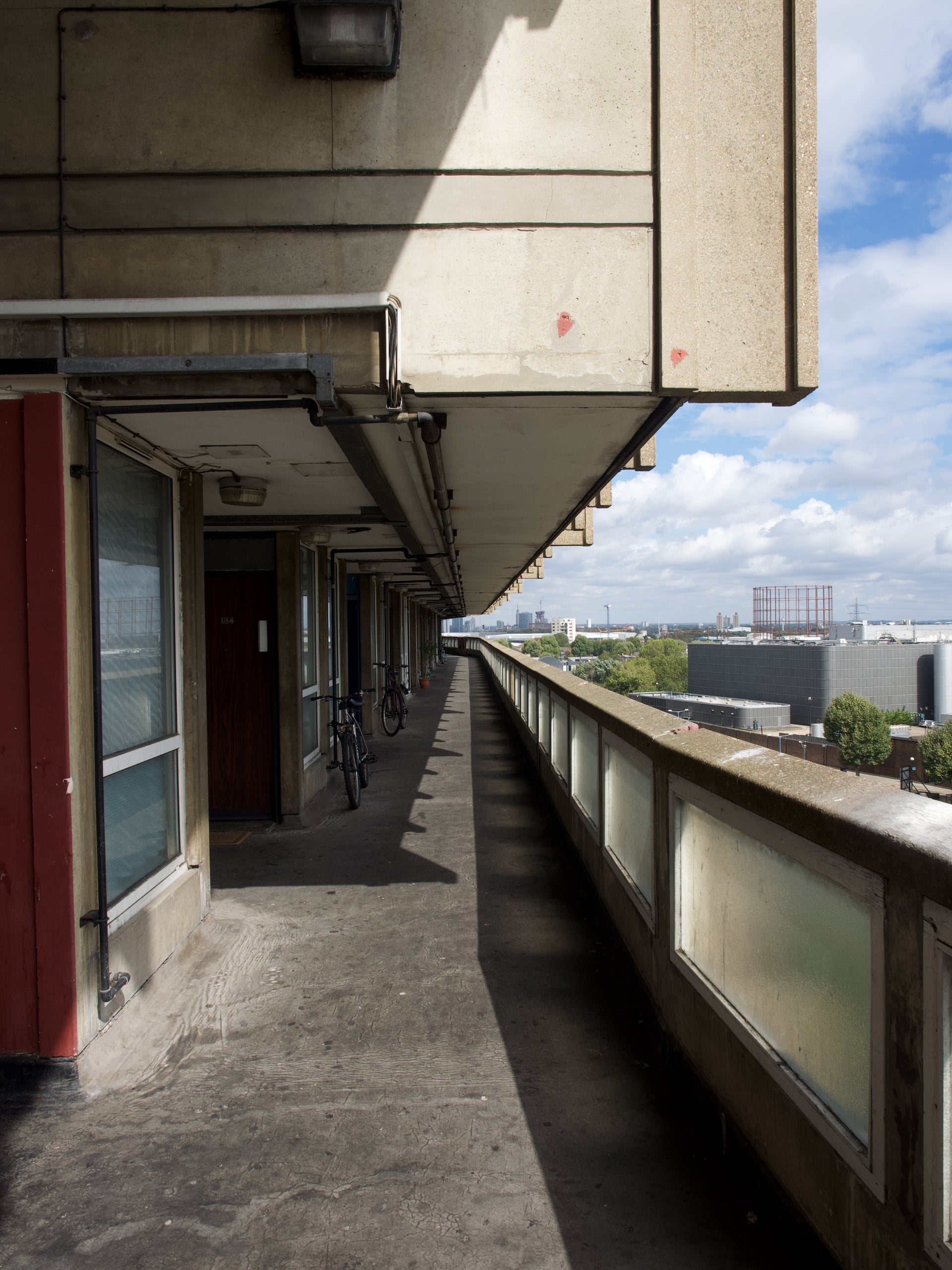
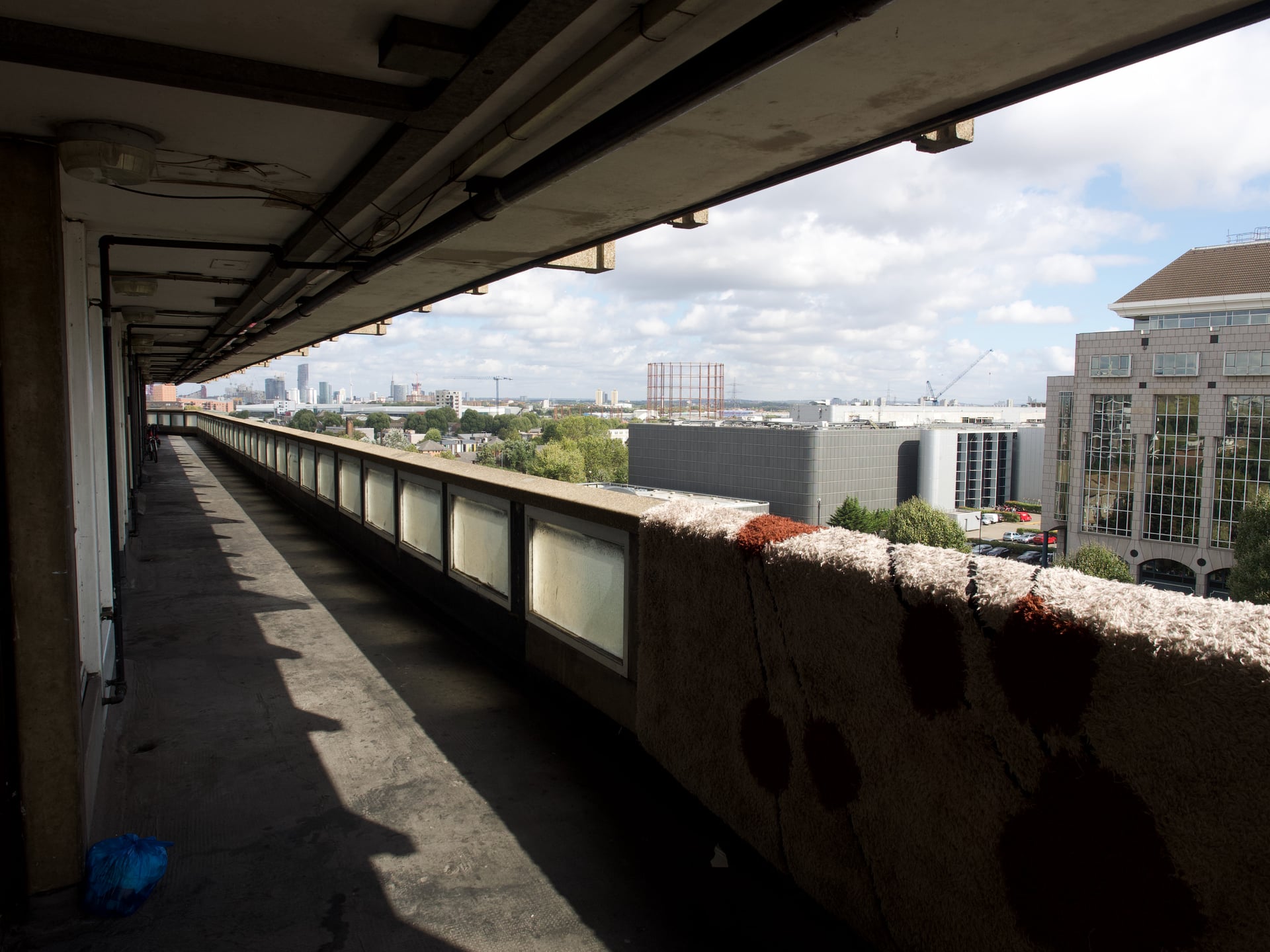
You know what they call this place around here? They call it Alcatraz. At least the people who don’t live in it do. My friends ask ‘How can you live there?’ but they can’t believe how nice it is inside.
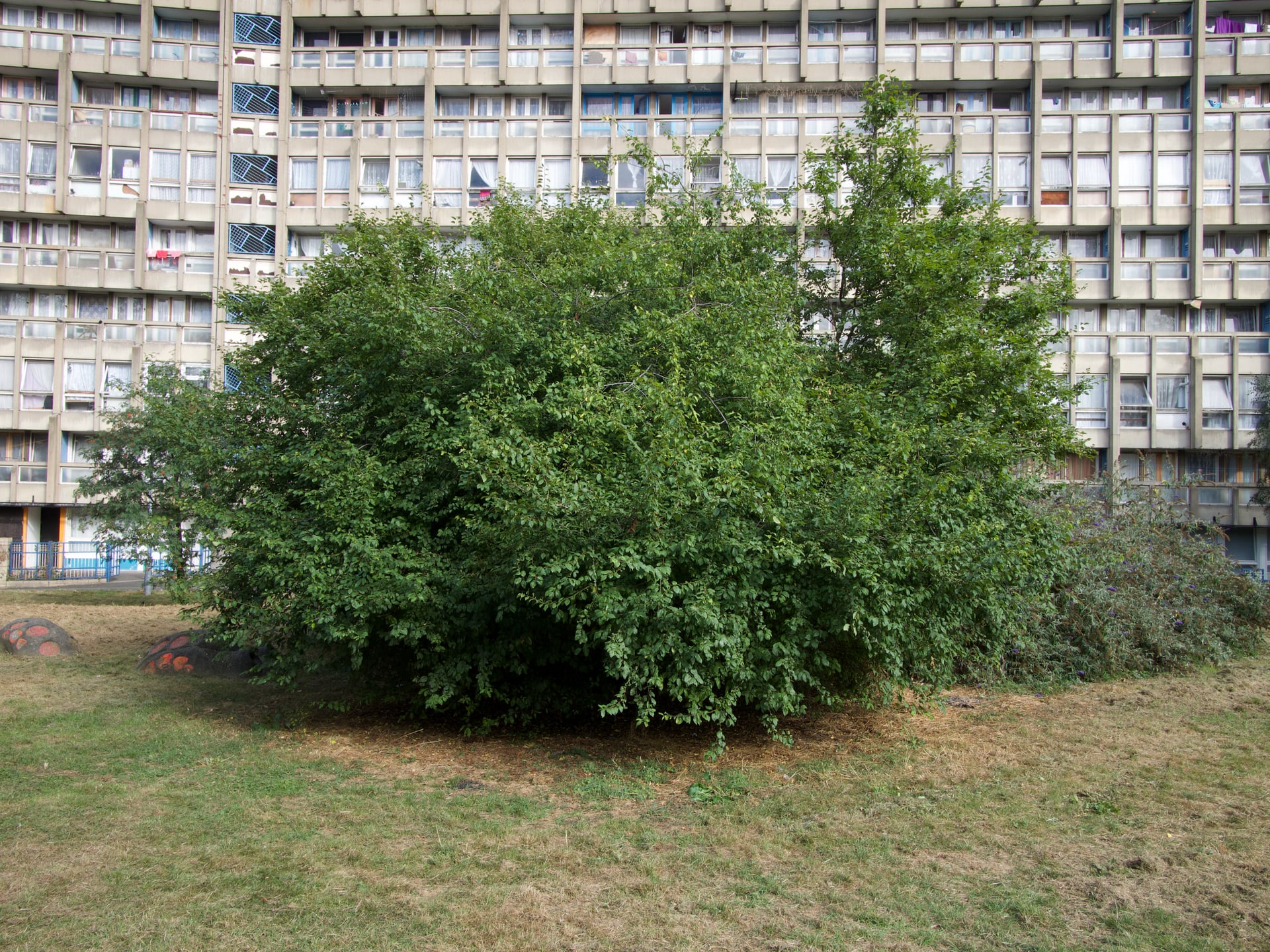
The decision, 2007–12
A survey in 2006 found defects in the outside walls, the roofs, the kitchens, the bathrooms and the wiring, according to Municipal Dreams.
The developer’s statement to the 2012 planning committee said it had been estimated in 2008 that putting this right would cost at least £20m. That was when the council adopted its plan for the area. The council’s own 2016 report gave about £21m.
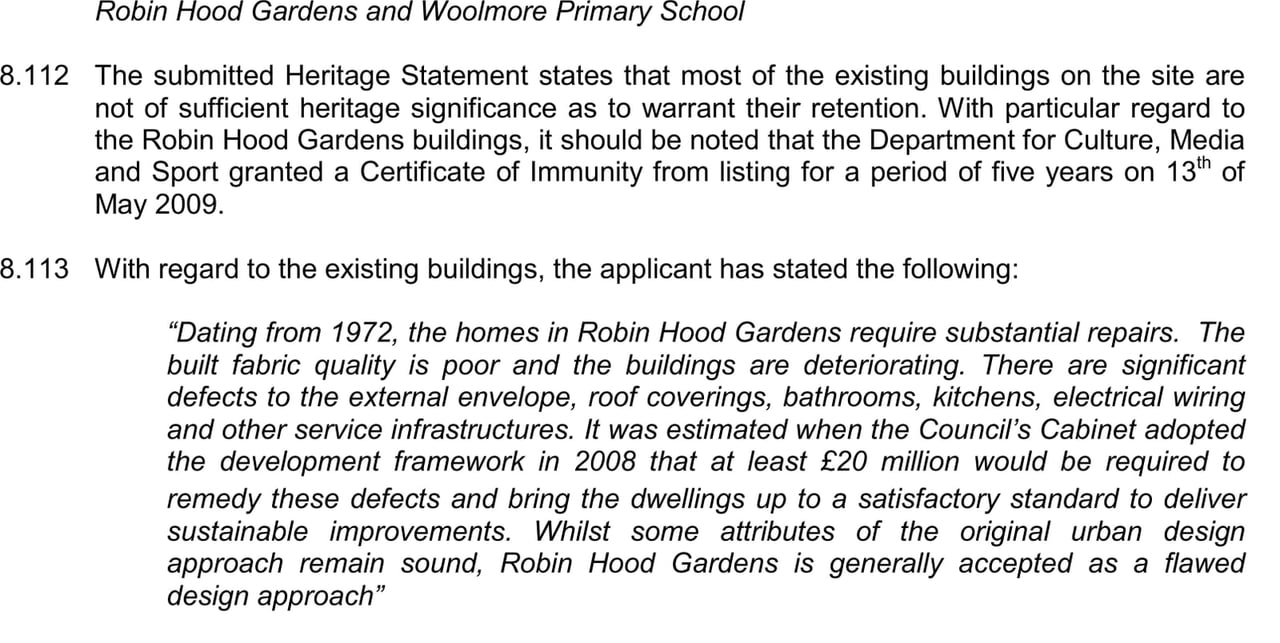
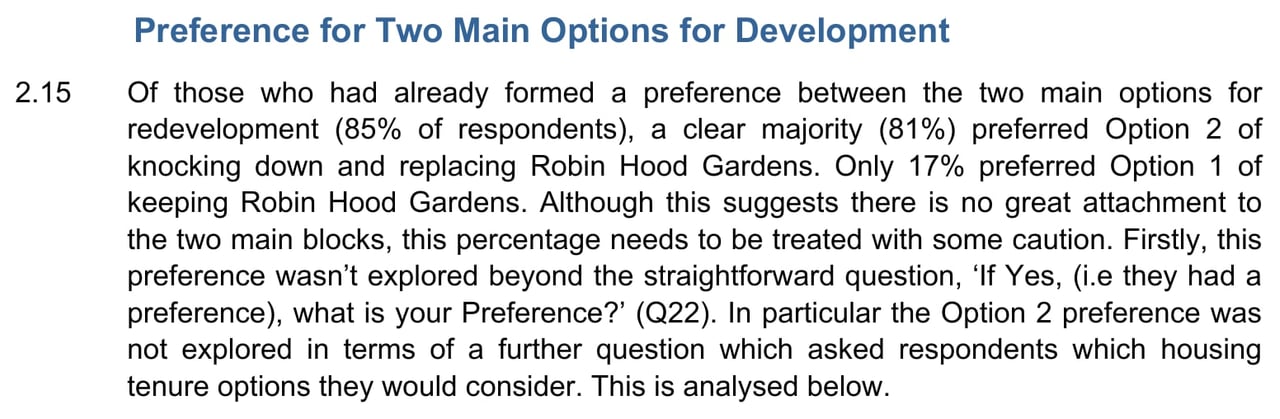
Between August and November 2007 consultants for English Partnerships asked people living in the area, which had about 300 households. They made 110 home visits. Of the households with a preference, 81% chose knocking the estate down and rebuilding, and 17% keeping it.
The consultants warned that the figure “needs to be treated with some caution”. Support was tied to being able to stay in the area and keep a council tenancy, and they called the consensus “a relatively fragile one”. 77% said they wanted to remain in the neighbourhood.
On 5 March 2008 the council’s cabinet agreed to demolish numbers 1 to 214. Tenants were given decant status from September 2008, with the option of a new housing association home or another council home through the decant. A petition against demolition was handed in at the meeting.
In July 2008 the culture minister, Margaret Hodge, refused to list the estate. “Anyone who wants to list that place should try living there,” she said later. “It is simply not fit for purpose.”
The Department for Culture, Media and Sport granted a five-year certificate of immunity from listing on 13 May 2009.
On 15 March 2012 the council’s planning committee voted five to nil for outline permission for up to 1,575 homes. Two residents of the estate were among the five speakers, on opposite sides.
Darren Pauling, a resident and chair of the Millennium Green Trust, said a petition he had carried out a few years earlier found that 120 of 130 households wanted refurbishment. He had used interpreters. Mohammed Yousuf, chair of the tenants’ and residents’ association, said most of its members supported the regeneration; the minutes record that residents were “sick of housing problems on the estate”.
The decant, 2008–24
I like the views from the windows, I like the light. It is close to the shops and the DLR station. The flat is good, it just needs fixing up
Miah told Delwar Hussain in August 2016 that his family had lived in the flat for just under a year, and that its condition was “the result of many years of neglect”.
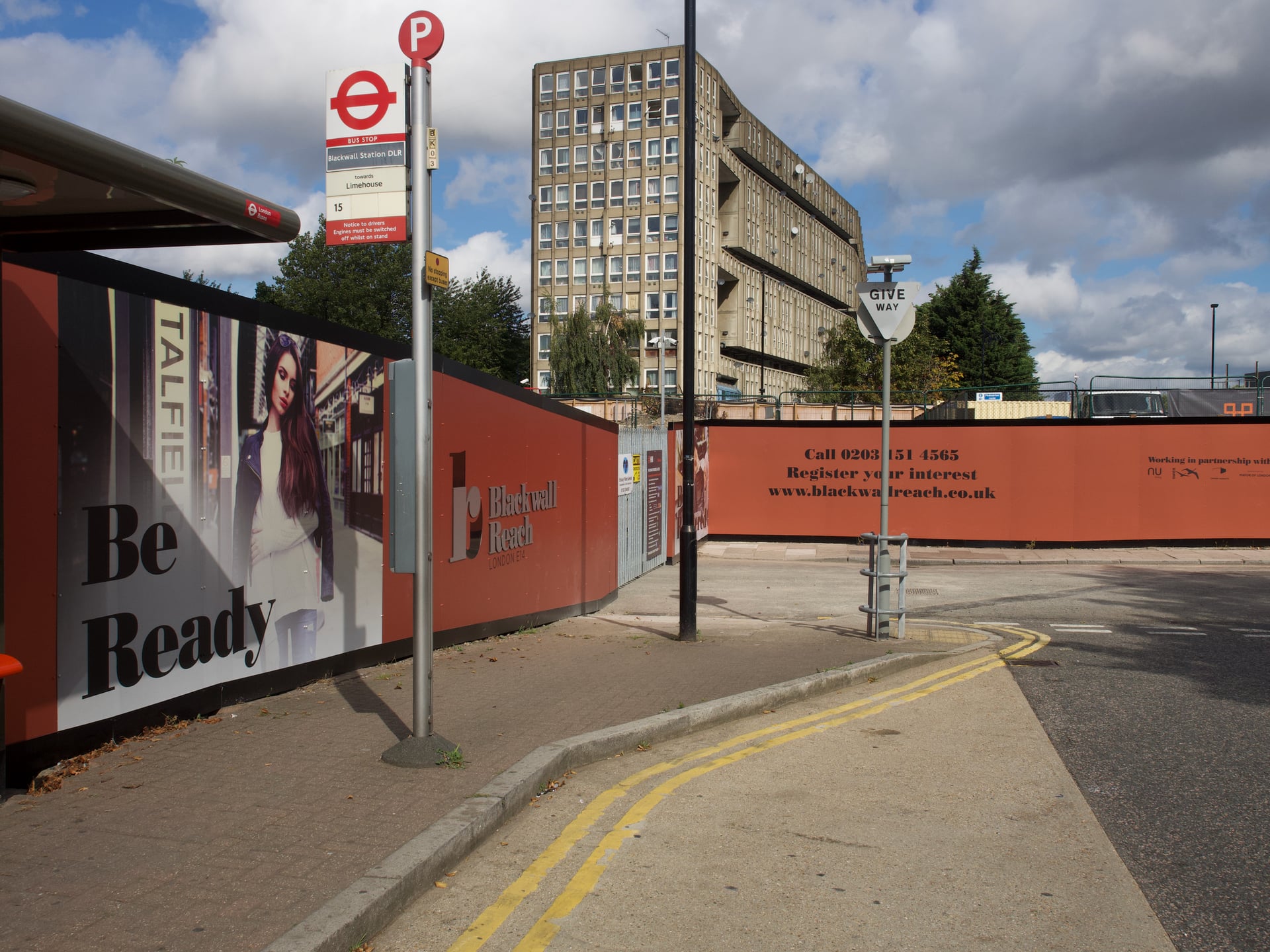
The first new homes were Phase 1A, at the north-west corner of the site: 98 homes, finished in March 2015. The council described them as “primarily for decanting tenants and resident home owners” from the estate.
Swan Housing, the developer, later said 79 were let to social housing residents and eight to other people living and working in Tower Hamlets. The rest went to leaseholders from Robin Hood Gardens. By July 2016, eleven resident owners had opted to move to a new Swan home.
At least one family had moved elsewhere in the borough by August 2016. The Ali family had lived on the estate for more than twenty years. They were in Mile End, in the first house they were offered, according to the writer Delwar Hussain.
By February 2016 everyone in the west block had been moved out, according to Thoburn. No published source says where each household went.
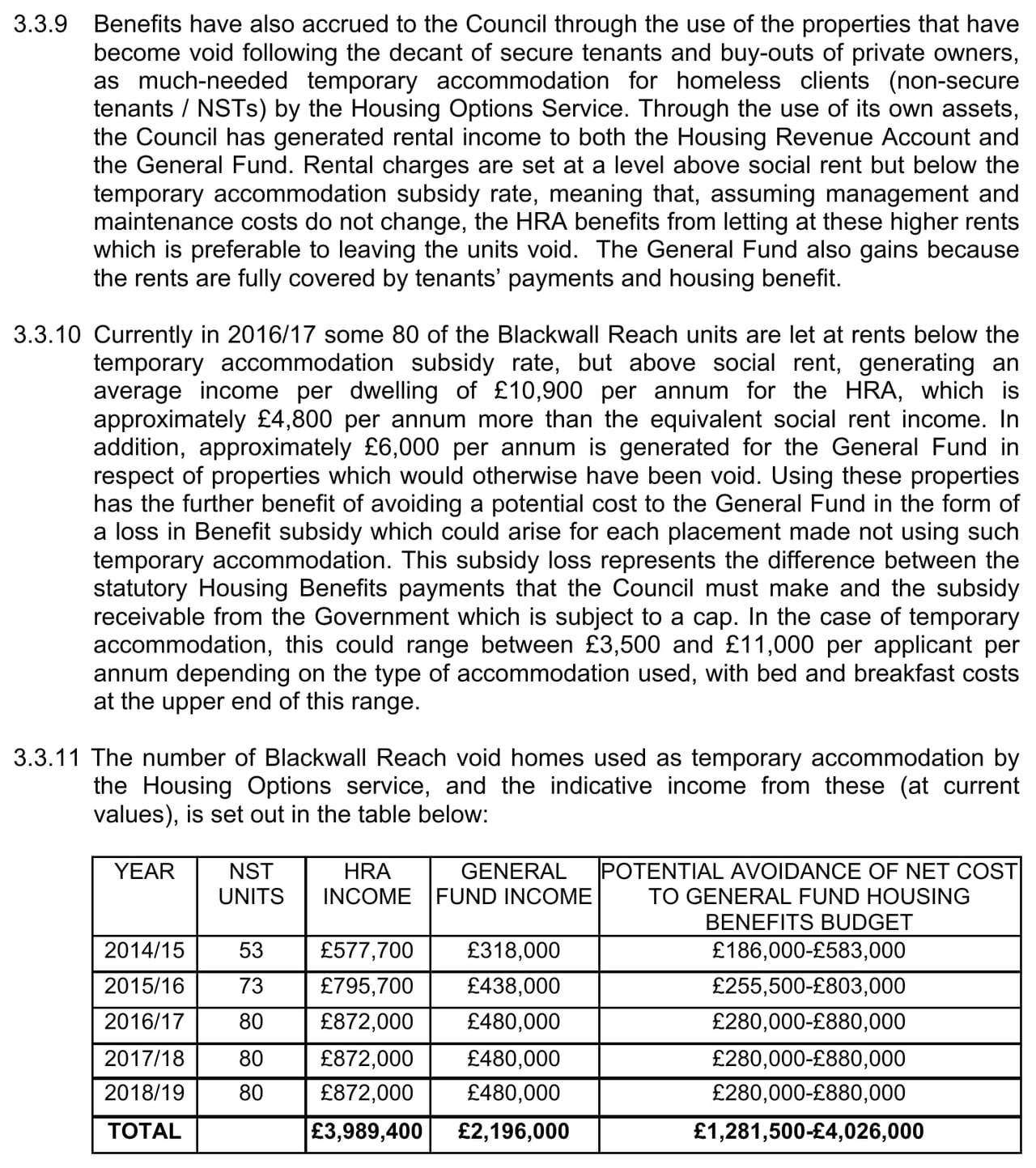
As flats emptied, the council let them to homeless households as temporary accommodation. Across the regeneration area, including homes bought from owners, it counted 53 such homes in 2014–15, 73 in 2015–16 and 80 in 2016–17.
The rents were set above social rent. By July 2016 they had brought the council’s housing account about £1.37m, and the council expected to need the east block empty during 2019.
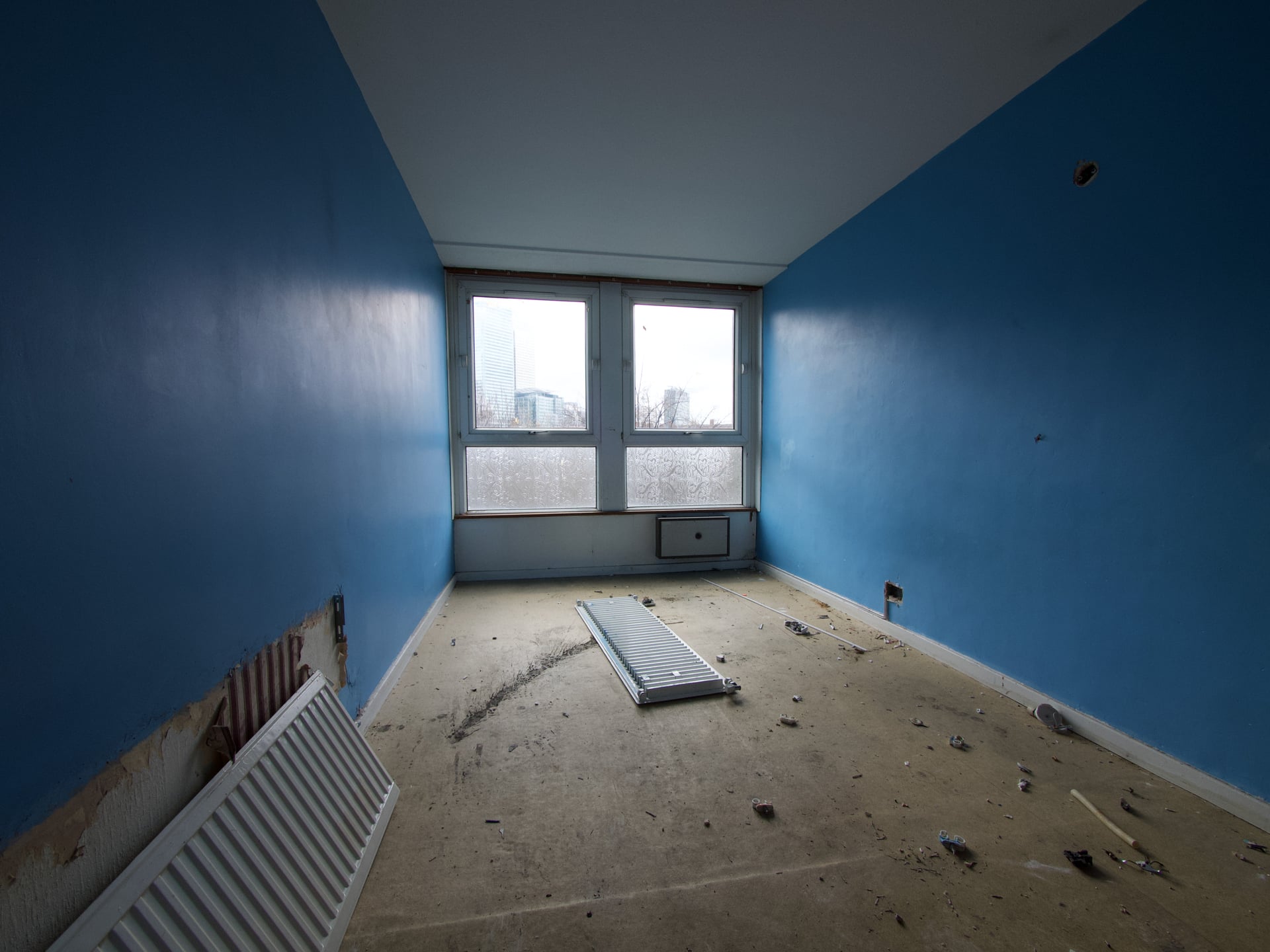
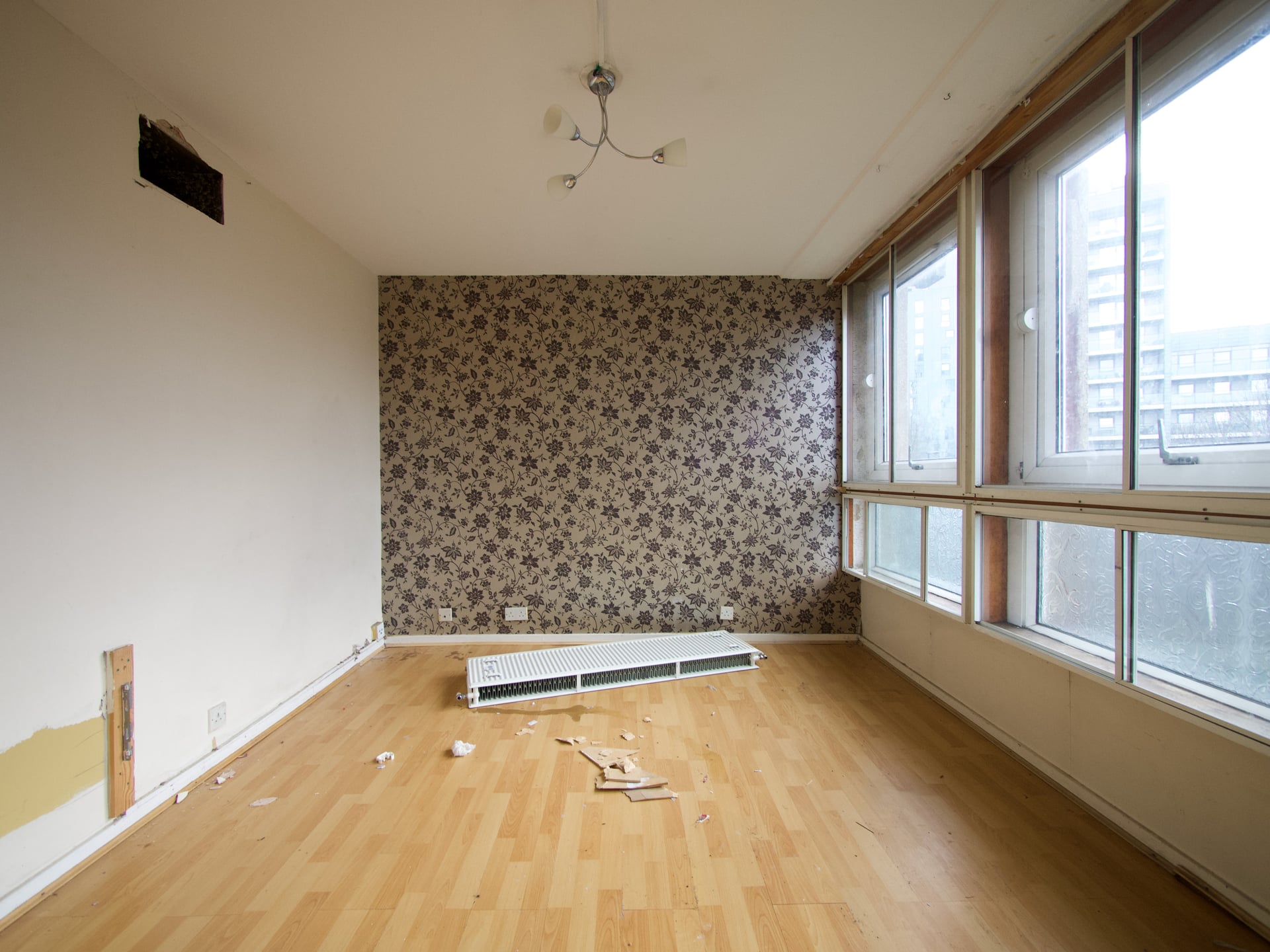
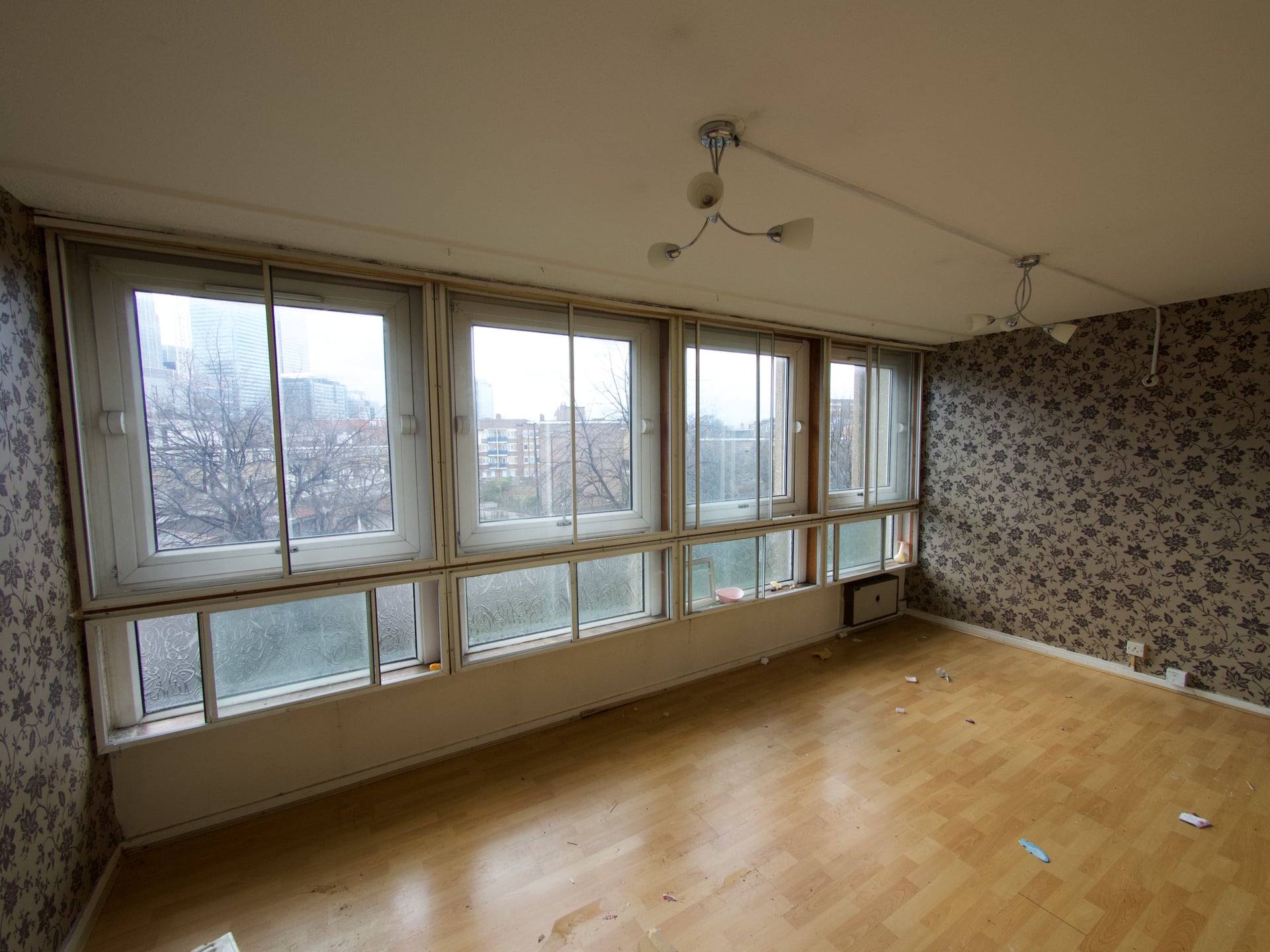
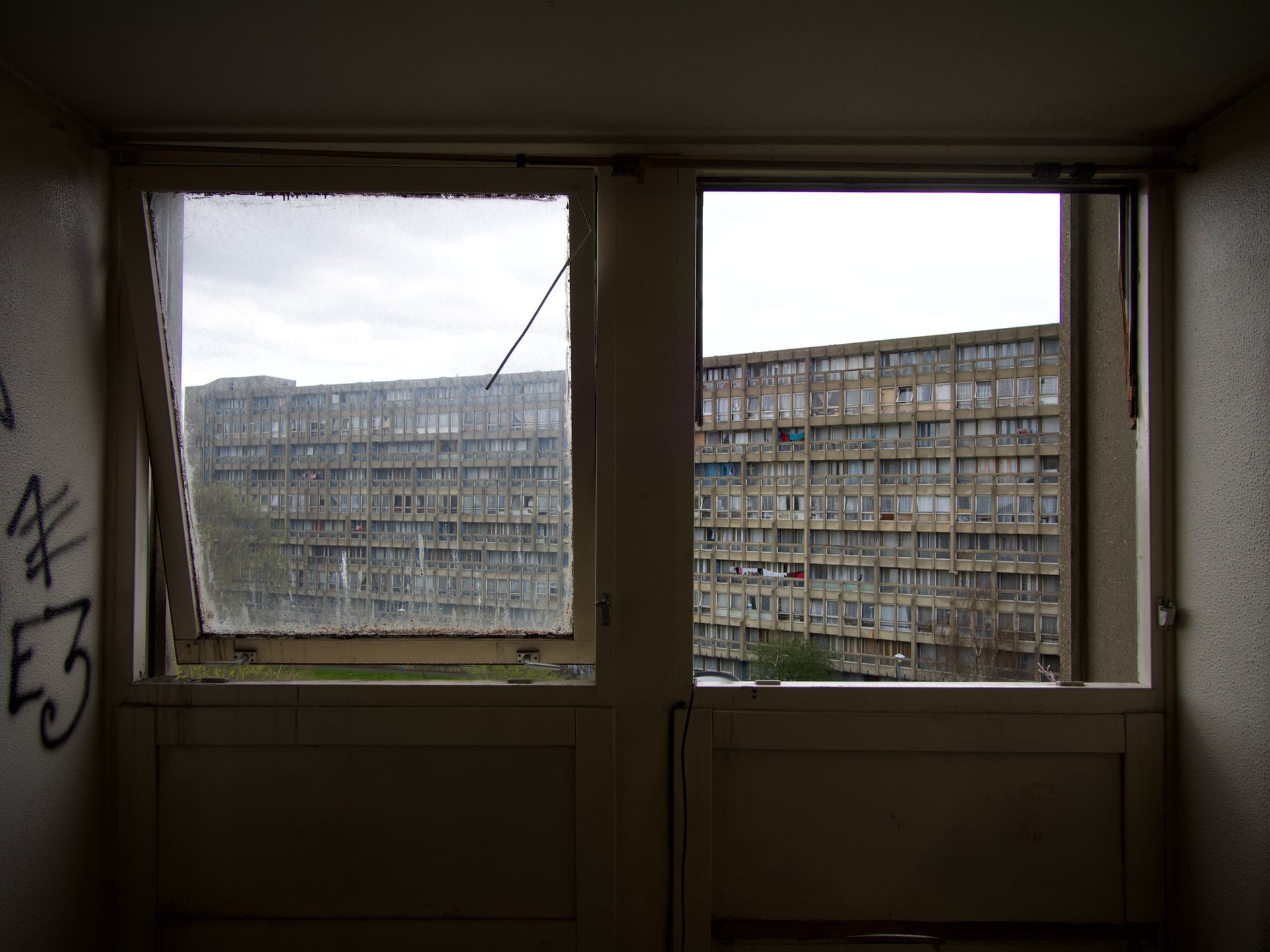
On 7 September 2017 Swan told the Architects’ Journal that 27 council tenants and six home owners were still living in the east block. They would not be moved before 2020, and some would be rehoused in the new homes on the site.
In January 2023 the council’s risk register recorded that every leasehold had been bought. Secure and non-secure tenants were “still to rehouse”, and notices seeking possession had been served.
In May 2023 a caretaker told The Sun that ten flats were still officially occupied, with “a lot more squatters”. The council said it had not yet been able to move the remaining households because of “a severe shortage of available homes in our borough”.
In 2016 Peter Luck and I wrote that the estate “was condemned by those who had never lived there and much liked by those who had”. That came from talking to visitors at an exhibition. The 2007 consultation and the two speakers in 2012 show residents divided, and the 81% for demolition came with conditions about staying.
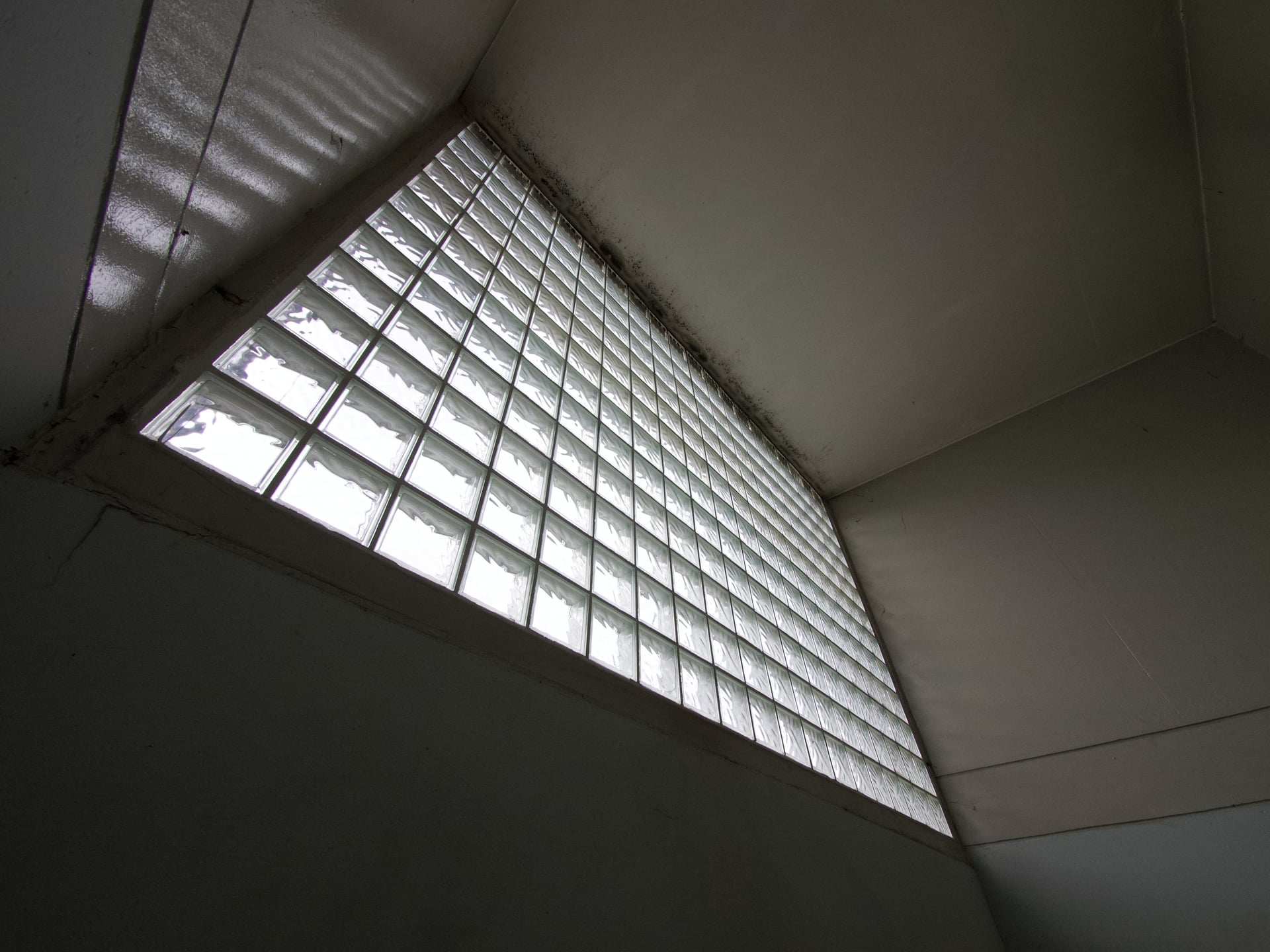
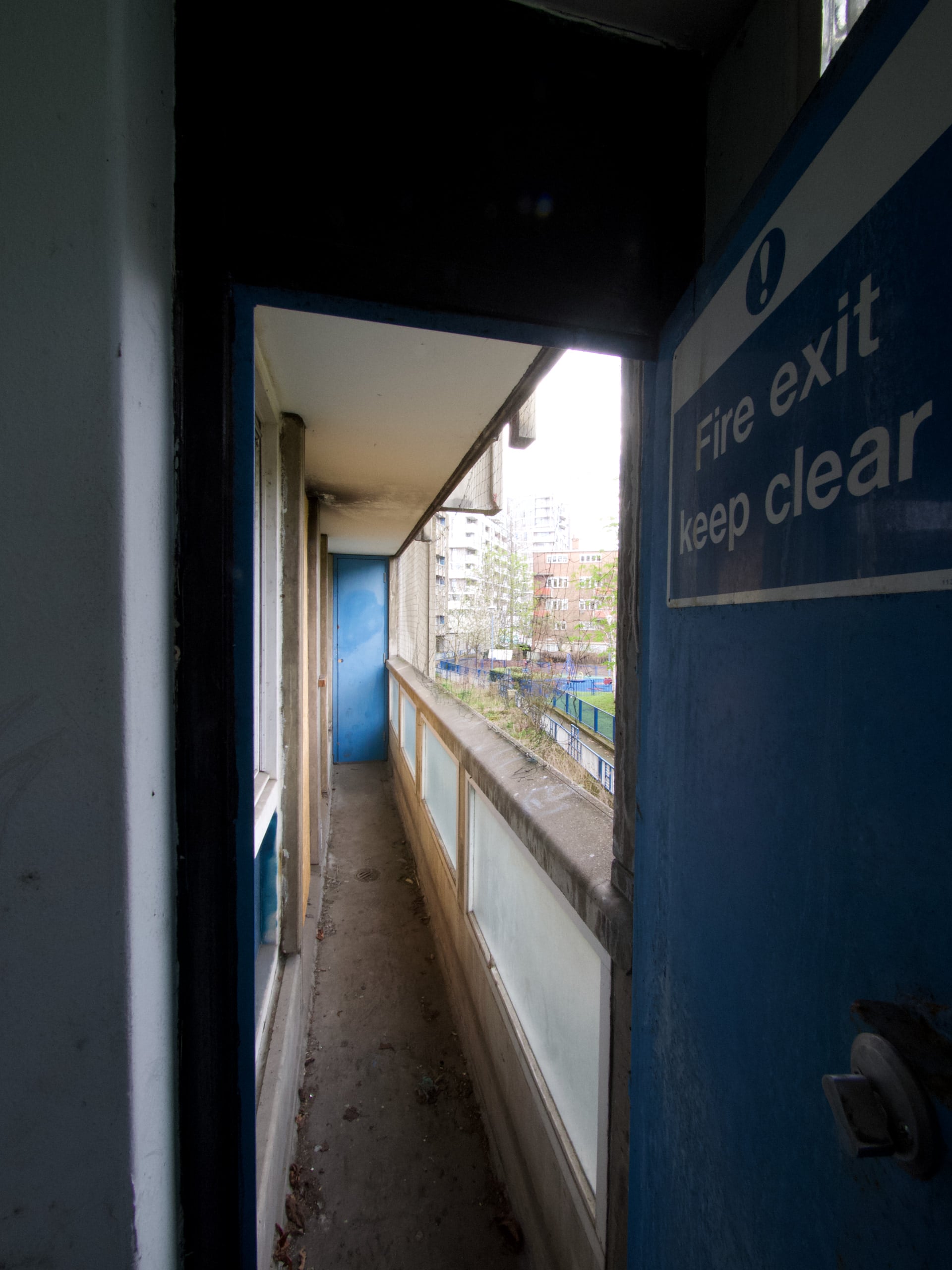
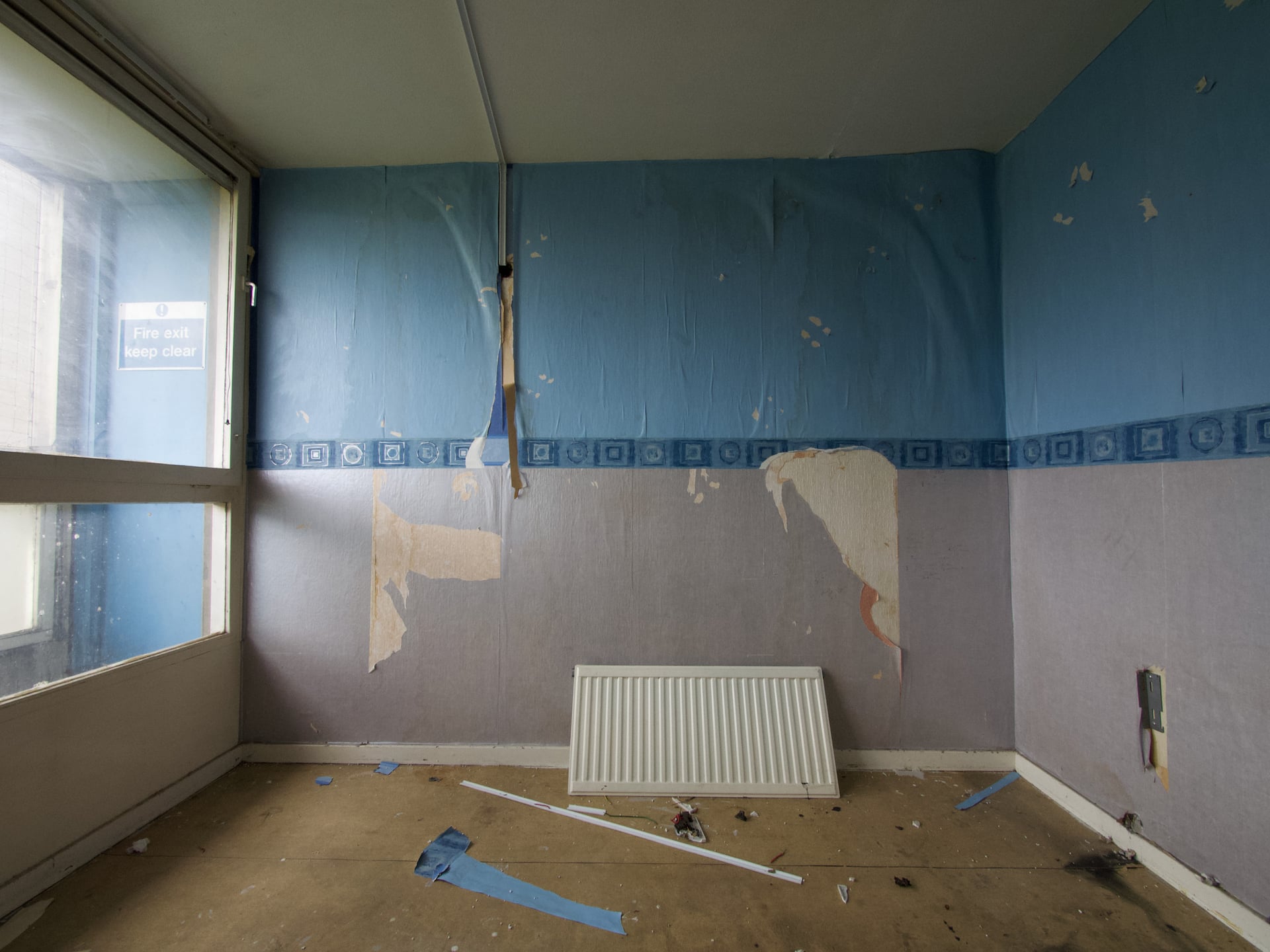
These photographs show the outside of a block where people lived, and rooms after the people had gone. They cannot show how anyone lived there, whether the estate should have been repaired, or where its tenants went. The records show repair estimates of £20m and more, and a council that chose to rebuild.
Demolition and after, 2017–26
Demolition of the west block began in December 2017. By May 2018 it had gone, and the east block, still lived in, could be seen from Cotton Street.
In 2017, before demolition began, the Victoria and Albert Museum acquired a three-storey section of the west block: both façades and the fittings of two flats. A 9m-high piece of it was shown at the 2018 Venice Architecture Biennale as Robin Hood Gardens: A Ruin in Reverse. In May 2025 it went on show at V&A East Storehouse, with recordings of former residents.
The east block stood for more than six years after the west block came down. Structural demolition began in December 2024.
Thoburn photographed the last section coming down on 12 March 2025. Sanctuary said on 7 May 2025 that demolition was still under way.
In 2017 the Mayor of London’s loan papers expected all five phases of Blackwall Reach to be finished by 2024–25. In May 2025 Sanctuary, which took over Swan in 2023, said more than 600 homes had been created, 214 of them allocated for social rent. A further 446 homes were approved in September 2025, and the programme now runs to 2031.
The ending was intended. Tower Hamlets decided on demolition in March 2008 and kept to it for seventeen years.
In 2012 a resident objector and the tenants’ chair both described twenty years of neglect. The wait was longer than the council’s own forecast: in 2016 it expected the east block to be empty during 2019, and tenants were still there in 2023.
Will the argument as to whether the right decisions were made continue? Almost certainly; and the final judgement cannot be predicted. Perspectives change.
Evidencewhat remains unknown
Chronology
- 1963: The London County Council commissions the Smithsons for Manisty Street, Poplar.
- 1966: A new brief from the Greater London Council, which replaced the LCC in 1965, for the enlarged site.
- 1968: Building begins.
- 1972: The estate is completed: 214 flats.
- 1974: Alison Smithson, “The Violent Consumer”.
- 2006: A condition survey finds defects (reported).
- 2007, August to November: English Partnerships consultation; 81% of those with a preference choose demolition. November: the Twentieth Century Society proposes listing.
- 2008, 5 March: cabinet agrees demolition and decant status from September 2008. July: Margaret Hodge refuses listing.
- 2009, 13 May: five-year certificate of immunity from listing.
- 2012, 15 March: outline permission resolved for up to 1,575 homes; 30 March: permission secured (GLA).
- 2014, January: my first visit. Emptied homes begin to be let as temporary accommodation (53 in 2014–15).
- 2015, March: Phase 1A, 98 homes, completed. August: Historic England again declines to recommend listing; the minister is minded to issue a second certificate of immunity.
- 2016, by February: the west block emptied. April and September: my visits. 16–18 September: Out of Time.
- 2017, 7 September: 27 council tenants and six owners remain in the east block. November: the V&A announces its acquisition. December: west block demolition begins.
- 2018, by May: west block demolished. Venice Architecture Biennale, A Ruin in Reverse.
- 2023, January: secure and non-secure tenants still to be rehoused from the east block. 8 February: Swan becomes part of Sanctuary. May: ten flats still officially occupied.
- 2024, December: structural demolition of the east block begins.
- 2025, 12 March: Thoburn photographs the last section coming down; on 7 May Sanctuary still describes demolition as under way. May: the V&A fragment goes on show at V&A East Storehouse. September: 446 more homes approved.
What remains unknown
- How many of the estate’s households moved into the new Blackwall Reach homes, and how many went elsewhere. No complete account of departure dates and destinations has been found, including for temporary tenants. Phase 1A’s lettings figures do not say how many came from Robin Hood Gardens.
- When the last secure tenant left the east block. The record shows tenants still there in May 2023 and demolition starting in December 2024.
- Whether three counts are the same exercise: the 130 of 140 households that Municipal Dreams says Darren Pauling found opposed demolition, the resident survey Building Design reported in June 2009, and the petition Pauling described in 2012 (120 of 130).
- The survey behind the £20m repair estimate, and the “£70,000 per flat” figure often quoted with it, which I have not found in a council document.
BibliographyEvery source this page quotes or shows
- Ella Braidwood, “In pictures: Robin Hood Gardens’ demolition begins”, Architects’ Journal, 7 September 2017. https://www.architectsjournal.co.uk/news/in-pictures-robin-hood-gardens-demolition-begins
- English Partnerships, Blackwall Reach Regeneration Project, Stage 1A: Statement of Community Participation, Phase 1 Consultation Report, published by the London Borough of Tower Hamlets, February 2008, executive summary and printed pp. 11, 28 and 31. https://democracy.towerhamlets.gov.uk/mgConvert2PDF.aspx?ID=7786
- John Furse, The Smithsons at Robin Hood, PhD thesis, 1982, University of Plymouth repository, as quoted by Municipal Dreams. https://doi.org/10.24382/3930
- Greater London Council, householders’ manual for Robin Hood Gardens, undated, as quoted in the Robin Hood Gardens: Out of Time history panels and by Municipal Dreams.
- Hermione Hobhouse (ed.), “Between Poplar High Street and East India Dock Road: Bazely, Wells, Woolmore, Cotton and Ashton Streets”, Survey of London, volumes 43 and 44, Poplar, Blackwall and Isle of Dogs, 1994, pp. 188–199. https://www.british-history.ac.uk/survey-london/vols43-4/pp188-199
- Historic England, “Robin Hood Gardens Estate”, August 2015. https://web.archive.org/web/20170328034819/https://historicengland.org.uk/whats-new/news/robin-hood-gardens
- Elizabeth Hopkirk, “Entire Robin Hood Gardens west block demolished”, Building Design, 8 May 2018. https://www.bdonline.co.uk/entire-robin-hood-gardens-west-block-demolished/5093451.article
- Elizabeth Hopkirk, “V&A buys part of Robin Hood Gardens”, Building Design, 9 November 2017. https://www.bdonline.co.uk/vanda-buys-part-of-robin-hood-gardens/5090507.article
- Will Hurst, “New Robin Hood Gardens residents survey challenges demolition”, Building Design, 26 June 2009. https://www.bdonline.co.uk/new-robin-hood-gardens-residents-survey-challenges-demolition/3143573.article
- Delwar Hussain, “Decanted From Robin Hood Gardens”, Spitalfields Life, 21 August 2016. https://spitalfieldslife.com/2016/08/21/decanted-from-robin-hood-gardens/
- Delwar Hussain, “Return to Robin Hood Gardens”, Spitalfields Life, 20 August 2016. https://spitalfieldslife.com/2016/08/20/return-to-robin-hood-gardens/
- London Borough of Tower Hamlets, Blackwall Reach Regeneration Project: Update Budget Report, Cabinet, 26 July 2016, paras 3.2.1–3.2.12, 3.3.9–3.3.12, 4.9 and 7.4. https://democracy.towerhamlets.gov.uk/documents/s89355/5.7%20Blackwall%20Reach%20Update%20Budget%20Report.pdf
- London Borough of Tower Hamlets, Cabinet, decision on CAB 136/078, Blackwall Reach Regeneration Project: Development Framework, decision and minutes, 5 March 2008. https://democracy.towerhamlets.gov.uk/mgAi.aspx?ID=13786
- London Borough of Tower Hamlets, “Demolition marks milestone in Blackwall Reach regeneration”, May 2025. https://www.towerhamlets.gov.uk/News_events/2025/May/Demolition-marks-milestone-in-Blackwall-Reach-regeneration.aspx
- London Borough of Tower Hamlets, Detailed Risk Report, 16 January 2023, entry HRG0009. https://democracy.towerhamlets.gov.uk/mgConvert2PDF.aspx?ID=211795
- London Borough of Tower Hamlets, Strategic Development Committee, report on PA/12/00001 and PA/12/00002, and minutes of the meeting, 15 March 2012, PDF pp. 56–58. https://democracy.towerhamlets.gov.uk/mgAi.aspx?ID=33865
- Peter Luck and James Wakefield, history panels, Robin Hood Gardens: Out of Time, Transition Photographers, Open House London, 16–18 September 2016.
- Tamlin Magee, “MP calls for Robin Hood Gardens’ demolition after failed listing bid”, Dezeen, 5 August 2015. https://www.dezeen.com/2015/08/05/politician-calls-immediate-demolition-robin-hood-gardens-listing-bid-fails-historic-england-brutalism/
- Mayor of London, decision MD2060, Poplar Riverside Housing Zone, Blackwall Reach, 3 January 2017. https://www.london.gov.uk/decisions/md2060-poplar-riverside-housing-zone-blackwall-reach
- Mayor of London Homes, “Blackwall Reach”, accessed October 2026. https://mayoroflondonhomes.london.gov.uk/development/blackwall-reach/
- Kois Miah and Nick Thoburn, “Demolition and Afterlife”, Brutalism as Found, exhibition website. https://brutalismasfound.co.uk/demolition-and-afterlife/
- Kois Miah and Nick Thoburn, “Streets in the Sky”, Brutalism as Found, exhibition website. https://brutalismasfound.co.uk/streets-in-the-sky/
- Municipal Dreams, “Robin Hood Gardens, Poplar: ‘an exemplar – a demonstration of a more enjoyable way of living’”, 4 February 2014. https://municipaldreams.wordpress.com/2014/02/04/robin-hood-gardens-poplar-an-exemplar-a-demonstration-of-a-more-enjoyable-way-of-living/
- Municipal Dreams, “Robin Hood Gardens, Poplar: ‘presence, dignity and a bit grim’”, 11 February 2014. https://municipaldreams.wordpress.com/2014/02/11/robin-hood-gardens-poplar-presence-dignity-and-a-bit-grim/
- Sanctuary, Blackwall Reach Phase 3 Community Update, issue 2, written by the principal contractor, Keltbray, December 2024. https://www.sanctuary.co.uk/sites/default/files/2024-12/blackwall-reach-contractor-newsletter-issue-2.pdf
- Sanctuary, “Blackwall Reach”, project page, accessed October 2026. https://www.sanctuary.co.uk/about-sanctuary/development-and-regeneration/blackwall-reach
- Sanctuary, “Demolition marks milestone in Blackwall Reach regeneration”, 7 May 2025. https://www.sanctuary.co.uk/news/demolition-marks-milestone-blackwall-reach-regeneration
- Emer Scully, “Our futuristic estate was once nicknamed ‘streets in the sky’… now it’s being DEMOLISHED – we’re the last ones left”, The Sun, 28 May 2023. https://www.thesun.co.uk/news/22459420/our-futuristic-estate-being-demolished/
- Alison and Peter Smithson, The Smithsons on Housing, directed by B. S. Johnson, BBC2, 1970, as quoted by Municipal Dreams.
- Alison Smithson, “The Violent Consumer, or Waiting for the Goodies”, Architectural Design, no. 5, 1974, pp. 274–279.
- Swan Housing Association, Annual Report and Financial Statements 2022/23, Sanctuary, 17 November 2023, p. 4. https://www.sanctuary.co.uk/sites/default/files/2023-11/swan-housing-association-annual-report-and-financial-statements-2023.pdf
- Swan Housing Association, “New project for Swan Housing Association”, published by C.F. Møller, 28 June 2017. https://www.cfmoller.com/g/New-project-for-Swan-Housing-Association-i16722.html
- Nick Thoburn, Brutalism as Found: Housing, Form and Crisis at Robin Hood Gardens, Goldsmiths Press, 2022. https://www.gold.ac.uk/goldsmiths-press/publications/brutalism-as-found/
- Townshend Landscape Architects, “Blackwall Reach Phase II”, project page, undated. https://townshendla.com/projects/blackwall-reach-phase-ii-85/
- Twentieth Century Society, “Robin Hood Gardens set for demolition as listing is refused”, 4 August 2015. https://c20society.org.uk/news/robin-hood-gardens-set-for-demolition-as-listing-is-refused
- Victoria and Albert Museum, “La Biennale di Venezia 2018”, 2018. https://www.vam.ac.uk/articles/la-biennale-di-venezia-2018
- Victoria and Albert Museum, “Robin Hood Gardens”, 2017. https://www.vam.ac.uk/articles/robin-hood-gardens
- Victoria and Albert Museum, “V&A East Storehouse – visual story”, 2025. https://www.vam.ac.uk/info/va-east-storehouse-visual-story